
UNCTAD Policy Brief No. 93, Emerging strategies for ports during the pandemic
The coronavirus (COVID-19) pandemic has had a significant impact on humankind and on global commerce. Ports and port communities have experienced major changes to normal operating environments.
The strategies used by ports to remain open and continue to facilitate sustainable economic development throughout the pandemic may provide useful lessons for policymakers, particularly in relation to the protocols and innovative measures that have been employed to mitigate the impact of the pandemic on the movement of imports and exports as well as ships’ crew and essential port workers.
Key points:
- Ports are essential facilitators of world trade
- Public health advice is crucial in mitigating the impact of pandemics
- Government policy and regulation is required to support port operations during pandemics
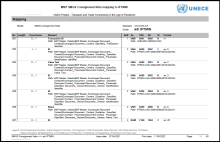
Data mapping of the IFTMIN UN/EDIFACT message and the SMGS and CIM/SMGS railway consignment notes to the UN/CEFACT Multimodal Transport Reference Data Model (MMT RDM)
The Data mapping of the IFTMIN UNEDIFACT message and the SMGS and CIMSMGS railway consignment notes to the UNCEFACT MMT RDM was developed as part of the United Nations response to the challenges of the COVID-19 pandemic under the United Nations multiagency project “Transport and Trade Connectivity in the Age of Pandemics: UN solutions for contactless, seamless and collaborative transport and trade”.
This electronic document equivalent Standard Package consists of the following elements:
The Model Subregional Agreement on Transport Facilitation
The Model Subregional Agreement on Transport Facilitation has been elaborated on the basis of findings of comparative studies between major subregional agreements on transport facilitation to which various ESCAP member States are parties, conducted in 2014-2015. It has been subsequently reviewed by two regional expert meetings held in 2015 and finalized with incorporation of ESCAP member States’ comments.
Specifications for an Electronic Quality Certification System for Fresh Fruit and Vegetables
This document presents the eQuality Certification system processes and business requirements for Fresh Fruit and Vegetables covered by marketing standards.
This document provides a high level functional description of the main business processes to be managed by an electronic Conformity Certificate management system for Fresh Fruit and vegetables. This functional system specification can be used as a template for the technical development and implementation of such a system.
Technical Specification for Uniform Customs Information Page in Central Asia
This Standard describes the installation and set up procedures necessary to deploy a specified information page at the web-sites of the Customs authorities of the Central Asian countries. Such page would contain all relevant information on border checkpoints in a universal and easy-to-use form.
Both documents are prepared in Russian.
Настоящий Стандарт описывает процедуры установки и настройки, необходимые для развертывания и введения в эксплуатаци. специализированной информационной страницы на веб-сайтах таможенных органов центральноазиатских стран. Такая страница будет содержать соответствующую информацию о пунктах пересечения границы в универсальной и легкодоступной форме.
Оба документа подготовлены на русском языке.
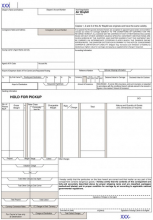
Air Way Bill Standard Package
The Air Way Bill Standard Package was developed as part of the United Nations response to the challenges of the COVID-19 pandemic under the United Nations multiagency project “Transport and Trade Connectivity in the Age of Pandemics: UN solutions for contactless, seamless and collaborative transport and trade” in cooperation with ICAO.
This electronic document equivalent Standard Package consists of the following elements:
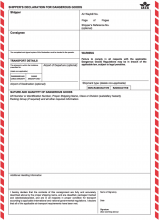
Air Dangerous Goods Declaration
The Air Dangerous Goods Declaration Standard Package was developed as part of the United Nations response to the challenges of the COVID-19 pandemic under the United Nations multiagency project “Transport and Trade Connectivity in the Age of Pandemics: UN solutions for contactless, seamless and collaborative transport and trade” in cooperation with ICAO.
This electronic document equivalent Standard Package consists of the following elements:
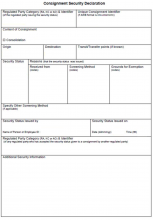
Air Consignment Security Declaration
The Air Consignment Security Declaration Standard Package was developed as part of the United Nations response to the challenges of the COVID-19 pandemic under the United Nations multiagency project “Transport and Trade Connectivity in the Age of Pandemics: UN solutions for contactless, seamless and collaborative transport and trade” in cooperation with ICAO.
This electronic document equivalent Standard Package consists of the following elements:
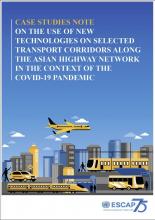
Seamless and smart connectivity along the Asian Highway network in the time of COVID-19
Freight transport operations poses the risks during the pandemics, especially if it is not fully computerized. As documents and goods continue to be subjected to physical checks for customs and other regulatory purposes, crew members and staff at border-crossing points and control terminals are exposed to the risk of contagion by the nature of their work. in this context, the use of information and communication technologies (ICT) and intelligent transport systems (ITS) is directly relevant to the pandemic response and recovery policies.Optimization of automation and digitalization can reduce the need for human interaction, making cross-borders transport safer and more resilient to disruptions. In this context, this technical note aims to offer policy recommendations for policy responses using new technologies and smart road solutions to preserve the regional transport connectivity in the time of the pandemics and other similar disruptions.
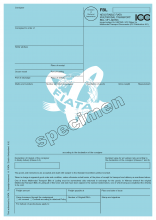
FIATA eFBL Standard Package
The FIATA eFBL Standard Package was developed as part of the United Nations response to the challenges of the COVID-19 pandemic under the United Nations multiagency project “Transport and Trade Connectivity in the Age of Pandemics: UN solutions for contactless, seamless and collaborative transport and trade”.
Available via FIATA’s GitHub repository, the data standard is offered as open source for all software providers and industry stakeholders to implement. FIATA expects its standard to become the main global standard for all House Bill of Ladings, noting the compatibility with other BLs.