Support to implementing best practices in TF in times of crisis and epidemic

20 - 24 June 2022
Conference
Virtual

This Initiative that brought together the United Nations Conference on Trade and Development (UNCTAD) and the five UN regional commissions for Africa (ECA), Europe (ECE), Latin America and the Caribbean (ECLAC), Asia and the Pacific (ESCAP), and Western Asia (ESCWA), with funding managed by the UN Department of Economic and Social Affairs, will come to an end soon in June 2022.
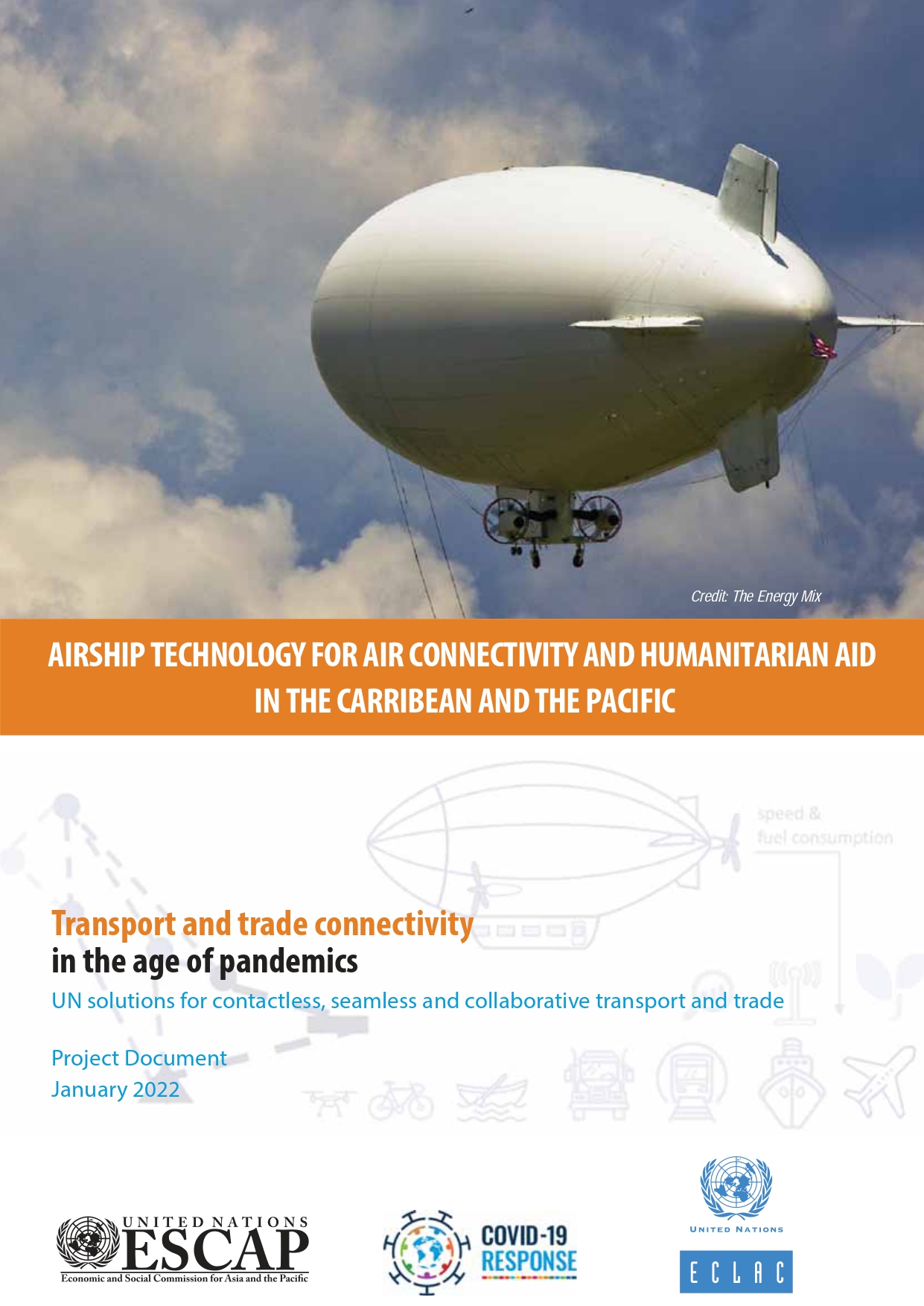
24 January 2022

The Airship transport alternative, in its diverse engineering variants, has the potential to be a game-changing technology with significant development in recent years. It offers the technical capabilities to make a broad contribution to the optimization of mobility and logistics networks in isolated communities and territories, especially but not only in Small Island Developing States (SIDS). This is particularly important in the context of the ongoing COVID-19 pandemic, as in the event of a disaster, different aid agencies are deployed with support in the distribution and logistics of perishable and essential cargo, equipment, and assistance personnel. This innovative mode should be incorporated into the transport matrix (both nationally and regionally), for the latter to move towards more efficient, sustainable, and resilient networks.

This report discusses the use of airship in the context of transport connectivity in SIDS and their vulnerability to disasters and associated challenges. The report presents the state of the airship´s technology, its flexibility, advantages, and study cases. It highlights a series of competitive advantages of airships for improving connectivity in SIDS and for addressing humanitarian, sanitary and environmental challenges across the local, regional, and global scales, as a resilient and sustainable logistics solution in synchro-modality with other modes of transport.

29 - 30 July 2020
Meetings
Virtual

he COVID-19 crisis and policy responses by Governments have highlighted the importance of enhancing trade and global value chain resilience to ensure access to essential goods and services - and accelerate recovery. In that context, ESCAP is organizing a first Expert Group Meeting on Trade Facilitation (TF) Measures in Times of Crisis and Epidemic, in order to identify good practices that countries have implemented during the crisis and develop a set of recommended measures that will help cope with future crises.

25 January 2021

The Coronavirus 2019 (COVID-19) pandemic has hit international trade worldwide and in Asia and the Pacific, underscoring the importance of maintaining trade connectivity not only for the immediate pandemic response, but also for the subsequent recovery efforts in order to build resilience to future disruptions. The report first describes, in the section II, the initial developments and lessons learnt in trade and transport facilitation practices in response to the COVID-19 pandemic. Section III presents the results of a Survey on trade facilitation in times of crisis and pandemic in the Asia and the Pacific region. Finally, Section IV discusses the ways forward for trade facilitation measures to support a sustainable and resilient recovery from the COVID-19 crisis and how the Asia-Pacific region can be better equipped to build back better. 

07 September 2020

The paper indicates that the SSWA countries have achieved remarkable progress in trade facilitation, especially as the COVID-19 crisis progressed. Although the policy responses in the initial months of the outbreak appeared to be fragmented and lacked coherence, countries in SSWA have shown convergence toward simplification of trade procedures, and enhanced transport and logistics and digital trade facilitation. While these measures have helped the SSWA countries secure supply of essential goods and services, some have simultaneously enforced stringent protection measures which represent a risk. The responses to the COVID-19 crisis suggest a greater scope of regional cooperation in the subregion. Digitalizing the trade processes in SSWA, including by signing on to the Framework Agreement on Facilitation of Cross-border Paperless Trade in Asia and the Pacific, would be the next step toward the needed paperless trade environment.

The world and regional economies have been hit hard by the COVID-19 crisis. The combined effects of the pandemic and global and national lockdowns have caused havoc in the countries of South and South-West Asia (SSWA), with their trade severely impacted. This paper investigates the subregion’s experience implementing trade facilitation measures in the times of COVID-19. The paper indicates that the SSWA countries have achieved remarkable progress in trade facilitation, especially as the COVID-19 crisis progressed.

Attachment

28 August 2020

The COVID-19 pandemic and associated attempts to contain its spread have created unprecedented hurdles to international trade. This paper reviews trade facilitation measures implemented in North and Central Asia (NCA), including transport and trade finance facilitation. All NCA countries have sought to protect the public health by restricting movement of people (including across borders) and applying special sanitary regulations at border crossings. These have included requirements to sanitize trucks, protect customs officials, change drivers, and requiring COVID-19 tests from drivers. Such requirements continue to create significant logistical issues, with often insufficient facilities for drivers. Sanitary requirements have proved simpler to implement for rail freight, creating an advantage for countries with well-developed rail networks. A number of common patterns emerge from the efforts of NCA countries to facilitate trade and transit.

The COVID-19 pandemic and associated attempts to contain its spread have created unprecedented hurdles to international trade. This paper reviews trade facilitation measures implemented in North and Central Asia (NCA), including transport and trade finance facilitation. All NCA countries have sought to protect the public health by restricting movement of people (including across borders) and applying special sanitary regulations at border crossings. These have included requirements to sanitize trucks, protect customs officials, change drivers, and requiring COVID-19 tests from drivers.

28 August 2020

Based on accumulated lessons and practices in ENEA countries during COVID-19 pandemic, the paper asses the measures that can be adopted by other countries in their battle against the pandemic. It also discusses measures that can be maintained in the post-pandemic “new normal”, as well as preparedness that should be institutionalized for future emergencies.

As countries in this sub-region begin to reopen and resume work, it is essential that we prevent a second wave of the pandemic, make supply chains more resilient and boost confidence in the global economy through strengthened coordination, as well as improved and holistic trade facilitation measures. Countries that have not yet implemented these trade facilitation measures should accelerate their process.

The COVID-19 pandemic is considered the most serious health crisis and the greatest challenge to humankind since the Second World War. Although countries in East and North-East Asia (ENEA) were the first to be hit by COVID-19, they have so far been successful in controlling the outbreak with relatively low fatalities, partially thanks to various containment measures.