Electronic trade and transport documents and data

02 March 2021

The CIM/SMGS Consignment Note URL Standard Package was developed as part of the United Nations response to the challenges of the COVID-19 pandemic under the United Nations multiagency project “Transport and Trade Connectivity in the Age of Pandemics: UN solutions for contactless, seamless and collaborative transport and trade”.

This electronic document equivalent Standard Package consists of the following elements:

02 March 2021

The CIM/SMGS Consignment Note Standard Package was developed as part of the United Nations response to the challenges of the COVID-19 pandemic under the United Nations multiagency project “Transport and Trade Connectivity in the Age of Pandemics: UN solutions for contactless, seamless and collaborative transport and trade”.

This electronic document equivalent Standard Package consists of the following elements:

02 February 2021

The Rapid Alert for Food & Feed (RASFF) Process has been compiled using the RASFF system and process of the European Commission and European Food Safety Authority (EFSA) as a base, with contributions of the Dutch Food Safety Authority and other relevant organisations. The generic design is offering Control Authorities in the domain of Health and Food Safety and other authorities (such as Customs)the opportunity to contextualize the information by using the UN/CEFACT Core Component Business Document Assembly (CCBDA) methodology.

The RASFF Standard package includes the following elements:

The RASFF process is to provide information about measures taken responding to serious risks detected in relation to food or feed from control authorities to a central Rapid Alert System. Whenever a member of the RASFF network has any information relating to the existence of a serious direct or indirect risk to human health deriving from food or feed, this information is immediately notified.

Attachment

02 February 2021

The  Cross-Industry Export Packing   List   process   has   been   compiled   within   the   context   of   the   United   Nations   Development  Account  (UNDA)  coronavirus  (COVID-19)  response  project  “Transport  and  Trade Connectivity in the Age of Pandemics”, with a view to increase the harmonization and standardization  of  data  exchange  in  international  transport,  trade  and  logistics  to  reduce  person-to-person contacts during the COVID-19 crisis and in the post-pandemic recovery.

The Export Packing List Standard package includes the following elements:

The current practice of the exchange of business documents by means of telecommunications – usually defined as e-Business presents a major opportunity to improve the competitiveness of companies, especially for Small and Medium Enterprises (SME). Started as an initiative by CEN/ISSS work shop eBES, the European Expert Group 1 (EEG1) – Supply Chain & e-Procurement  developed  the  Cross-Industry processes  in  2006.

Attachment

02 February 2021

The tracking of a consignment, goods or transport equipment is imperative to a success of a supply chain operation, accurate and timely status updates allow the Consignor and Consignee to plan and manage the flow and timing, identifying exceptions early on so that risk and disruption can be minimised. The status reporting processes can cover ad-hoc reporting (request) or contractual reporting (subscription).

The Equipment Status Report package includes the following elements:

The Consignment Status Report package includes the following elements:

Attachment

02 February 2021

The Waybill is the evidence of a contract between the Transport Service Buyer and the Transport Service Provider, it is usually issued on collection or receipt by the Transport Service Provider. The waybill is used as a document of title and to show who has the right of ownership of the goods being transported.

The waybill is a common term covering various terms used in different modes of transport, for example;
• Bill of Lading, Ocean Bill of Lading, or Sea Waybill is used in Sea freight
• Air Waybill or eAWB is used in Airfreight
• Consignment Note (CMR or eCMR) is used in Road
• Rail Transport Document CIM and SGMS are used in Rail

The Waybill package includes the following elements:

Attachment
Document

02 February 2021

The Shipping Instructions are variously known as Shipping Instructions, Forwarding Instructions, Shippers Letter of Instruction and would typically follow the Booking from the Transport Service Buyer to the Transport Service Provider as a pre-cursor to the issuing of a waybill which then acts as the evidence of the transport contract.

The Shipping Instructions package contains the following elements:

Attachment

02 February 2021

Bookings form an integral part of the ‘Buy-Ship-Pay’ model where the transportation of goods is not only using available capacity offered by a Transport Service Provider but binds the supply chain together with a Transport Plan. This provides multiple interested parties with the planned movements of a consignment journey from which the delivery of service can be executed and measured.

The Booking Standard Package package contains the following elements:

The Booking process is not a single ‘act’ but (can) comprise a series of transactions over time between a Transport Service Buyer and the Transport Service Provider.

New booking models aligned with the provision of advance data for operational planning (e.g. defining a transport plan/route map) used to monitor and track performance supporting a culture of ‘delivered as promised’, with the omnipresent demand for earlier visibility, scrutiny and assessment of data for trade facilitation and regulatory compliance.

Attachment
Document

02 February 2021

The current practice of the exchange of electronic messages for transport and logistics using UN/EDIFACT has provided a trusted and stable environment to communicate efficiently between actors in the supply chain since its introduction in 1990. The ongoing digitalization of supply chains, introduction of IoT devices such as smart containers, eCMR, and adoption of data pipeline principles in the transport and logistics domain processes raises new data requirements and migration path between these UN/EDIFACT messages and the Multi Modal Transport Reference Data Model (MMT RDM) is a key move to support future requirements.

The International Forwarding and Transport package contains the following elements:

Attachment

27 January 2021

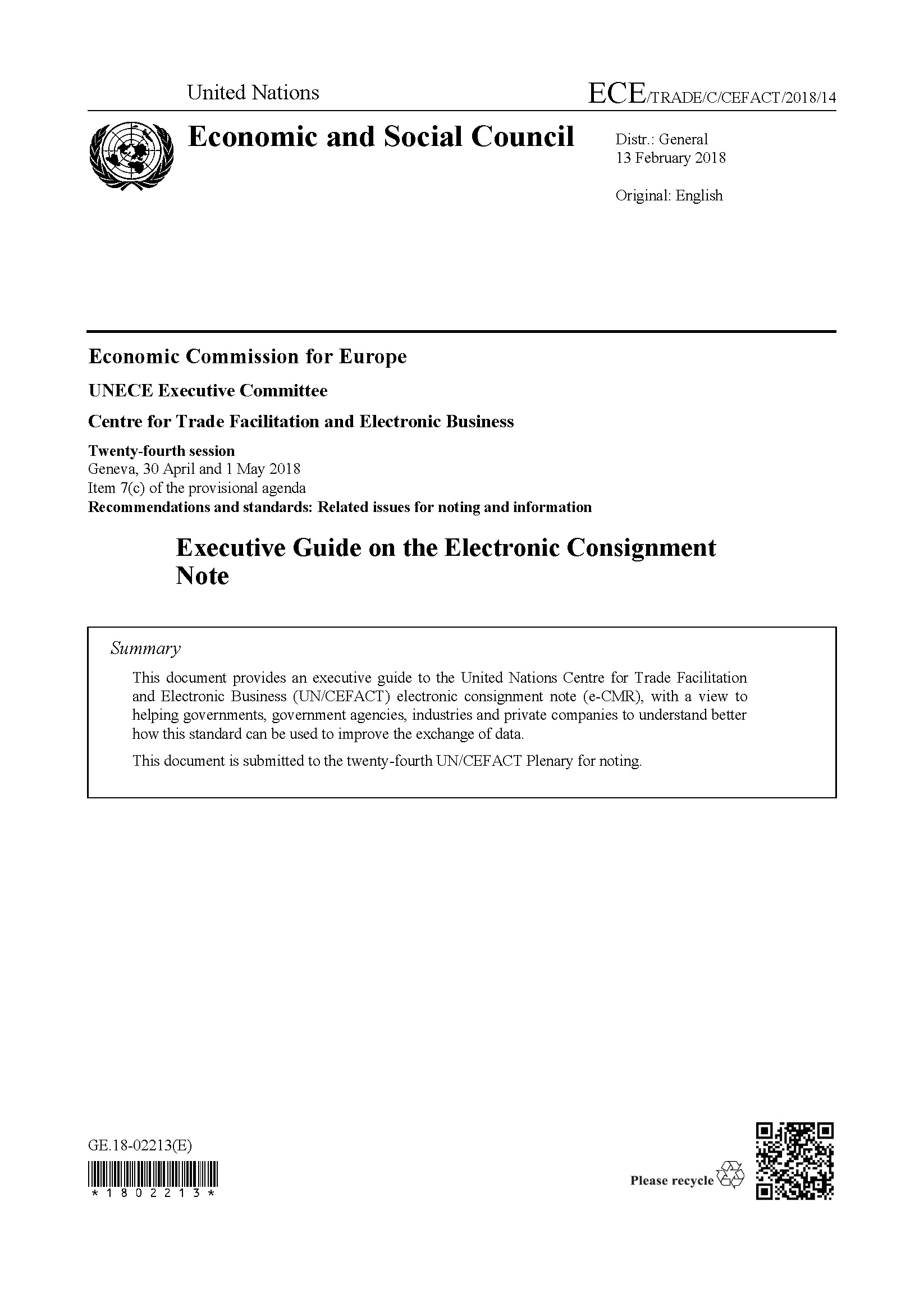
The Convention on the Contract for the International Carriage of Goods by Road (CMR) was developed in 1956. This convention standardizes contractual and carrier liability conditions of transporting goods by road in vehicles for reward if the origin and destination are in two different countries, and at least one of the countries is a contracting party. It has been acceded to by 55 states around the world, thus making the use of the CMR obligatory in these countries. In 1976, the International Road Union introduced a United Nations Layout Key aligned CMR Note template in cooperation with the International Chamber of Commerce. This road consignment note template was updated in 2007 and is now used by most, if not all, parties to contracts of carriage in CMR contracting countries.

The Convention on the Contract for the International Carriage of Goods by Road (CMR) was developed in 1956. This convention standardizes contractual and carrier liability conditions of transporting goods by road in vehicles for reward if the origin and destination are in two different countries, and at least one of the countries is a contracting party. It has been acceded to by 55 states around the world, thus making the use of the CMR obligatory in these countries.

Attachment